I’ve done some hard thought, and decided a great place to start my blog would be the Solar System. It is everything the average human knows, and nobody has ever ventured outside of it. Though it is only one star and its system of planets, moons, and other bodies, it is humongous to us. Our universe is known to have hundreds of billions of galaxies, with hundreds of billions of stars in each of those. So, let’s zoom in on one of those stars: the Sun!
The Sun
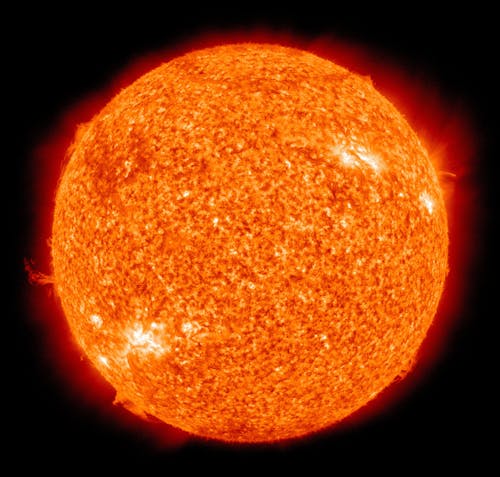
The sun is our star and is the center of our solar system and its eight planets. Without the sun, we could never survive. The sun, and all stars, go through a process called nuclear fusion, which is when high pressure at the core causes two hydrogen nuclei to fuse (join together) to form one helium nucleus. Once the sun fuses all of its hydrogen, it will begin to fuse two helium nuclei to form carbon. We’ll talk more about this later, but for now I want to talk about the planets!
The Planets
There are currently eight planets in our solar system. The reason I said currently is because Pluto, a dwarf planet, was considered our ninth planet until 2006 when a new definition of “planet” came about. The order of our planets from closest to the sun and furthest from it is Mercury, Venus, Earth, Mars, Jupiter, Saturn, Uranus, and Neptune. And, the order from greatest in size to smallest is Jupiter, Saturn, Uranus, Neptune, Earth, Venus, Mars, and Mercury. Now, for some basic information about each planet.
Mercury
Mercury is an interesting planet due to its exosphere, (like a magnetosphere, and shields from radiation) which is made of hydrogen, helium, potassium, sodium and oxygen. The planet formed about 4.5 billion years ago, when gravity pulled some of the remaining dust and gas from the Sun’s formation into a tight ball to form Mercury. Since Mercury doesn’t have an atmosphere, temperatures can vary greatly, between 800 degrees (427 degrees Celsius) Fahrenheit by day, and -290 degrees Fahrenheit (-180 degrees Celsius) by night. Mercury is also an average distance of 36 million miles (about 58 million kilometers) from the sun. Mercury’s period of revolution (year) is about 88 Earth days. Its surface is very rocky, and has craters all over, just like Earth’s moon. Mercury’s radius is 1,516 miles (2440 kilometers) making it the smallest planet in the solar system. It is so small it is only a little bit larger than Earth’s moon. Furthermore, Mercury does have a magnetosphere, but is only 1% the strength of Earth’s. Magnetospheres are used for shielding planets from solar or cosmic radiation, so Mercury is much more vulnerable to those types of radiation.
Venus
Venus is also a very neat planet in that it is almost the same size as Earth. Venus, as I have said above, is the hottest planet even though it isn’t closest to the sun. This is due to its thick atmosphere that can trap heat, just like Earth. Venus orbits the sun at a distance of around 67 million miles (108 kilometers), but this can vary because of its elliptical orbit. Venus, like Mercury, has no moons or rings. High up in Venus’ atmosphere, acid clouds thrive and occasionally rain. This means any space probe on the surface would get acid all over it. Venus’ day lasts about 243 Earth days, which is longer than its year of 225 Earth days!
Earth
Earth is our home planet, and orbiting the Earth is the moon. Earth only has one moon, though Saturn has over 80! On Earth, we experience perfect living conditions. We have a thick enough atmosphere to hold in heat, and to gain a magnetosphere to protect us from solar and cosmic radiation. Earth orbits the sun at an average distance of 93 million miles (about 150 million kilometers) away. We are the third planet from the sun, and the largest of the inner planets. Our atmosphere is composed of 78% nitrogen, 21% oxygen, and smaller percentages of other materials.
Mars
Mars is my favorite planet due to its scientific significance in modern times. It was named after the Roman god of war. Humans plan to land on Mars by 2024, and have full-blown cities by 2050 or 2060. But, at the moment, Mars cannot support life without a space suit. This is because its average temperature is -81 degrees Fahrenheit (about -63 degrees Celsius), Mars lacks a magnetosphere to shield from radiation, the pressure is far too low, gravity is only 38% of Earth’s and that there are only tiny amounts of oxygen in the atmosphere, the rest being 96% carbon dioxide, about 2% nitrogen, and about 1% argon. The reason Martian surface is red is due to the iron oxide, which is just a fancy way to say rust, in the soil.
Jupiter
Jupiter is yet another fascinating planet, as it is the largest, and is the first outer planet, in distance from the sun. Jupiter has 79 moons, four of which are the Galilean moons named after their discoverer. Those moons are Ganymede, Callisto, Io, and Europa. They are main study targets for science, as they seem habitable. Jupiter orbits the sun at an average distance 448 million miles (778 million kilometers), and is about 86,881 miles in diameter (about 140,000). Amongst the clouds of Jupiter, the temperature averages a chilly -234 degrees Fahrenheit (145 degrees Celsius). At the core of the planet, temperatures can soar to over 43,000 degrees Fahrenheit (24,000 degrees Celsius). Jupiter also boasts the largest storm in the solar system, which is twice the size of Earth and has been going on for over 100 years. Although many people believe Saturn is the only planet to have rings, Jupiter has its own, faint set for itself, as do the rest of the outer planets. Though Jupiter is the largest planet, it’s not the densest, due to its buildup of mostly hydrogen and helium gases.
Saturn
Saturn is the sixth planet from the sun, and is the least dense, though it is the second largest. This is because it is made of loosely compact atoms of hydrogen and helium. Saturn orbits the sun at an average distance of 870,000,000 miles (1,400,000,000 kilometers). Saturn’s average temperature in the clouds near the surface is -288 degrees Fahrenheit (-178 degrees Celsius), and that’s pretty cold! Saturn has 82 moons, but it is most famous for its beautiful rings. The tiny pieces of ice and dust number in the thousands, to make up the ring system. Saturn’s day lasts 10.7 hours, and revolves once around the sun in 29 Earth years.
Uranus
Uranus is the seventh planet from the sun and is composed mainly of hydrogen, helium, and methane. The planet is more than four wider than Earth, and is one of the outer planets. It is a gas giant, though it contains a lot of ice, too. A day on Uranus lasts about 17 hours, and a full year takes about 84 Earth years. Uranus is 1.8 billion miles (2,896,819 kilometers) away from the sun, and it takes light about 2 hours 45 minutes to get to the planet. The planet’s diameter is an impressive 31,518 miles (50,723 kilometers) in diameter. It’s radius is 15,759 miles (25,362 kilometers). Uranus is made of water, methane, and ammonia fluids above a small rocky center. Its atmosphere is made of hydrogen and helium like Jupiter and Saturn, but it also has methane. The methane makes Uranus blue.
Neptune
Neptune sits about 2,780,000 miles from the sun (4,480,000 kilometers). Neptune’s atmosphere is made up mostly of hydrogen, helium and methane. Neptune is about 2.8 billion miles (4.5 billion kilometers) away from the sun, so it takes sunlight about 4 hours to reach it. Neptune has a diameter of 30,599 miles (49,244 kilometers), and a radius of 15,299.4 miles (24,622 kilometers). Neptune’s year is 165 Earth years, and its day is 16 hours. When Neptune formed, it was likely closer to the sun, but has since moved to the outer solar system. Neptune’s solid core is covered with liquid water and other other melted ices. Neptune also boasts the fastest winds in the solar system, reaching speeds of 1,200 mph! Neptune has 14 moons, and faint rings, as do all the other outer planets.
More Blogs to Come!
I really hope you enjoyed learning about each planet, and the sun. We will definitely have more posts, going more in-depth on each planet. Anything having to do with science, we might cover on this blog. Talk to you soon!
Bibliography:
- Planets in order of size-universetoday.com/36649/planets-in-order-of-size/
- Mercury facts-solarsystem.nasa.gov/planets/mercury/in-depth/
- Mercury temperature-space.com/18645-mercury-temperature.html
- Magnetopheres-science.nasa.gov-heliophysics/focus-areas/magnetosphere/ionosphere
- Venus facts-solarsystem.nasa.gov/planets/venus/overview/
- Earth facts-solarsystem.nasa.gov/planets
- Mars facts-solarsystem.nasa.gov/planets/venus/overview/
- Jupiter facts-solarsystem.nasa.gov/planets/jupiter/overview/
- Saturn facts-solarsystem.nasa.gov./planets/saturn/overview/
- Saturn temperature-www.space.com/18473-saturn-temperature
- Sun picture-pexels.com/search/sun/
- Uranus facts-solarsystem.nasa.gov/planets/uranus/overview/
- Neptune Facts-solarsystem.nasa.gov/planets/neptune/overview/
 The Shooting Star Science Blog